
The Right Equipment to Get the Job Done
We have a wide range of aquatic and land equipment in our inventory, ready to deploy when and where it is needed.

Amphibious Excavator
Built to travel lightly over soft ground and to work from the water, our amphibious excavator reaches areas that conventional machines cannot, with little disturbance to the land around it. It digs silt and sediment out of ponds, lakes and streams and pulls complete root systems from wetlands. With a flail attachment, it cuts vegetation on steep banks and trims branches hanging over waterways so boats can pass. In winter, a forestry mowing head lets it clear invasive woody growth such as willow and glossy buckthorn from wetlands and isolated upland areas.

Weedoo
Dense aquatic vegetation can choke a pond, block access, and crowd out the plants that belong there. Removing it physically, rather than treating it in place, is often the right choice. This is especially true near sensitive areas or where we want to take the plant material out of the water altogether.
Our Weedoo is a shallow-draft workboat with quick-change attachments for cutting, raking, and collecting vegetation. It works in tight spaces and shallow water where larger harvesters cannot go. It also removes plant material in one pass instead of leaving it to decay in the water. Because it does not rely on chemicals, it gives us another low-impact option, and we use it alongside our other aquatic vegetation tools as the site calls for.

Truxor
Our amphibious weed harvester clears nuisance aquatic vegetation from ponds and lakes, from algae to rooted plants. Interchangeable attachments let it cut and rake growth, and it trims cattails and phragmites below the waterline. Fitted with a pump and hose, it also removes sediment hydraulically. Its low ground pressure tread carries it from the bank into the water without damaging the shoreline. The result is faster, cleaner and more affordable removal of unwanted vegetation and sediment.
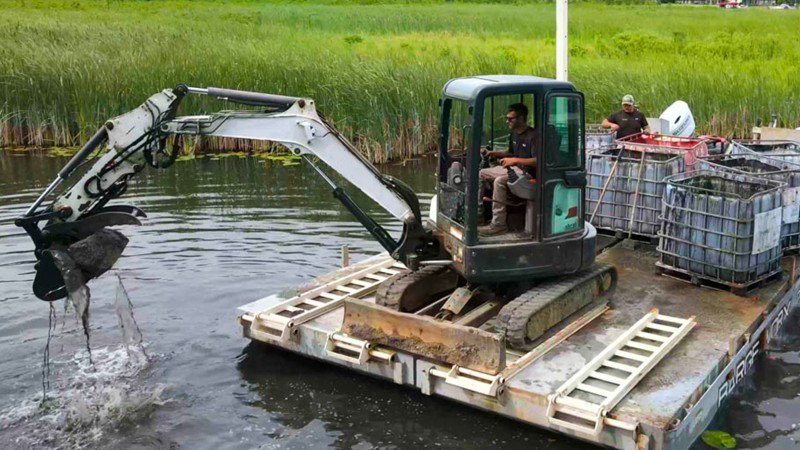
Barge Dredging
We perform mechanical dredging from a barge, using an excavator mounted on a floating platform. Dredged sediment goes straight into containers on deck, so material is collected as the work moves across the pond. When the containers fill, the barge returns to shore, where a vacuum truck with a sealed holding tank draws the sediment out through a hose. This closed transfer is fast and clean and keeps spillage to a minimum.

Long Reach Excavator
Left alone, trees and brush creep onto pond banks, berms, and wetland edges, where roots weaken slopes and crowd out native plants. Our long reach excavator can reach out over the water's edge to remove trees and other vegetation from banks that are too steep, soft, or wet for other equipment, while the machine stays on stable ground.
The same reach is just as useful for sediment. When material builds up in hard-to-reach areas or across a pond basin, the long reach excavator can remove it from the bank without putting equipment on soft ground. This protects the shoreline and keeps our crews safe.

Dino Sediment Removal System
Some sediment jobs are too confined for a barge and too far from solid ground for an excavator. Small retention ponds, sediment lagoons, community lakes, golf course water features, municipal water bodies, and small marinas often fall into that gap. These sites often call for minimal disturbance and present access challenges.
Our portable, low-impact hydraulic dredge was built for exactly those sites. A cutterhead loosens settled material on the bottom, and a submersible pump draws it up and sends it through a discharge line. Water stays in the pond. The same dredge can also be used with geobags, or geotextile tubes, to restore shorelines. Dredged sediment is pumped into bags secured to the shoreline. Once the bags are cut open, the sediment dries and is graded into a natural, safe shoreline.
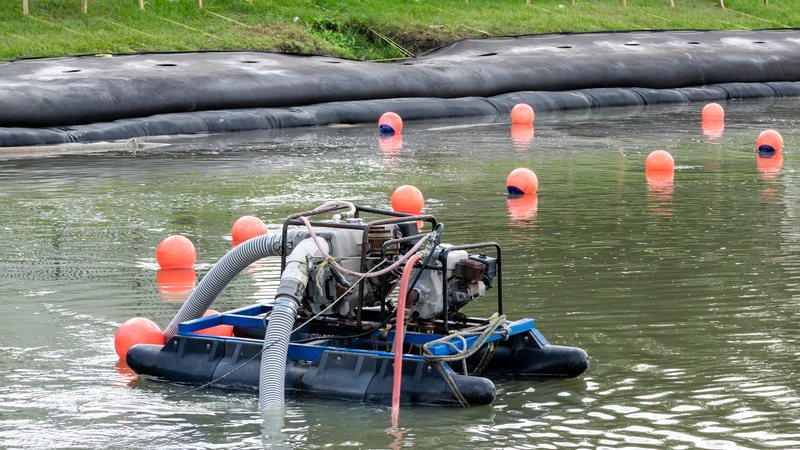
Pump Dredge
Not every pond can be dredged with a barge or an excavator. Tight access, finished landscaping, and soft banks can make heavy equipment a poor fit, but sediment still builds up and reduces depth over time.
Our pump dredge floats on the water and works from the middle of the pond, so heavy equipment does not need to drive along the banks. It loosens sediment and moves it through a discharge line to a containment area, such as a geotextile tube. The water drains back out and the sediment stays contained. That approach usually means less disturbance to landscaping and a smaller crew footprint. Where it makes sense, we can reuse the sediment to rebuild shorelines.
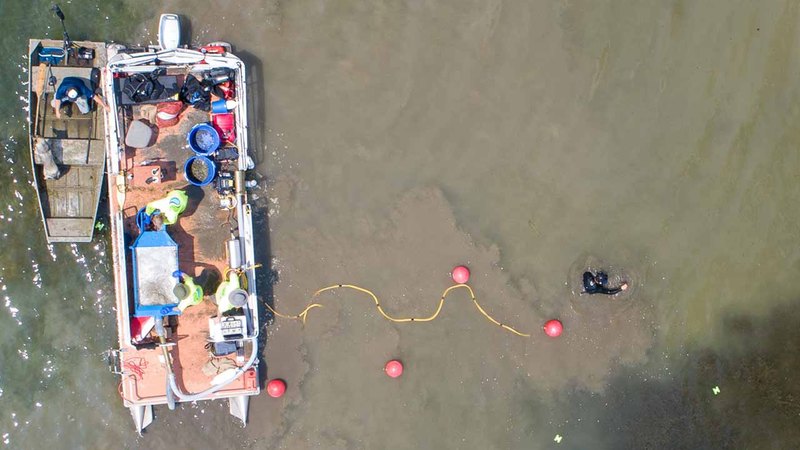
D.A.S.H. Boat & System
Chemical herbicides are not always the right answer for unwanted aquatic plants. Diver Assisted Suction Harvesting, or D.A.S.H., removes them by hand instead. Our divers are trained ecologists who can tell invasive and nuisance plants from the native plants a pond needs. They pull each unwanted plant out with its roots, so the plant is much less likely to grow back from the same spot.
The divers feed what they pull into a suction tube that carries it up to our boat for hauling away. Native plants stay in place to keep providing oxygen, food, and habitat for fish and wildlife. D.A.S.H. works well for clearing a swimming area, removing weeds that tangle in boat propellers around a dock, or cleaning up a shoreline before an event. You can see the results as soon as the work is done.

Airboat Spray Rig
Some water cannot be reached by a standard boat. Shallow coves, dense vegetation, and the edges of large ponds and lakes can all be difficult to work around. Our airboat spray rig is built for these conditions. Its flat hull and fan propulsion let our crews move across shallow water and thick plant growth without a propeller below the surface.
Our licensed applicators use the rig to treat unwanted aquatic vegetation and algae across a large area in a single trip. This keeps treatments precise and efficient, and it lets us cover big lakes and hard-to-reach shorelines for HOAs, commercial properties, and municipalities.
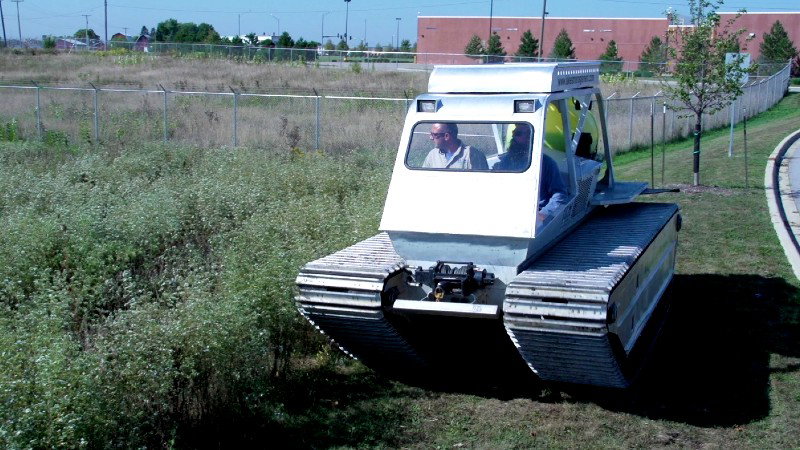
Marsh Master
Invasive plants often take hold deep inside a wetland, far from any road or firm ground. That is where our tracked marsh vehicle earns its place. On prescribed burn days, it carries a large supply of water to help crews keep the fire under control. For restoration projects, it spreads seed across open ground, and through the growing season it cuts back dense emergent growth. When invasive species need treatment, crews can focus on a single patch or cover an entire stand in one pass. Because the vehicle travels through the marsh itself, crews reach the interior of the wetland rather than only its edges.
MOBITRAC
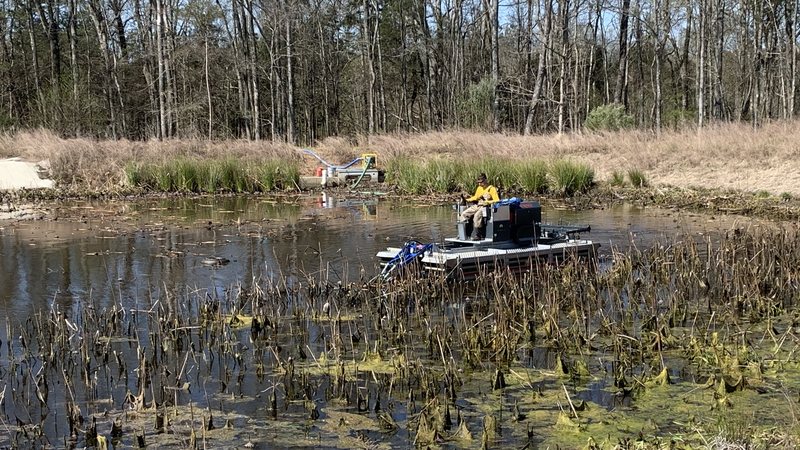
Dense cattails, shoreline vegetation, and organic buildup are difficult to manage from the bank, and the water is often too soft or shallow for a boat or a heavy machine. Reaching those areas safely takes equipment designed to work on both land and water.
Our MOBITRAC is a lightweight amphibious machine that moves between the bank and the water, so our crews can reach marsh edges, pond coves, and other hard-to-access areas. Quick-change attachments for cutting, raking, and collecting let one operator remove plant material and debris efficiently and take it out of the water instead of leaving it to decay. Its light footprint helps protect banks and sensitive areas, and it keeps our crews off unstable ground.

Forestry Equipment
Our forestry equipment, including multiple skid steers allows us to provide superior control of invasive woody species. With fecon forestry mowing and tree sheer attachments we can quickly and efficiently remove large and small woody species for our clients.
Another unique piece of equipment used by our team for woody control is a mid-size excavator or ‘midi’. Implementing a forestry mowing attachment on the boom of the midi allows for woody clearing on steeper slopes where a skid steer would not have safe access. The midi is also used on environmental construction projects involving grading and excavating.

Ventrac
Steep banks, berms, and spillway slopes are some of the hardest areas to maintain, and they are often where vegetation gets ahead of a property. Mowing them with a conventional tractor can be unsafe for the operator and rough on the ground.
Our Ventrac is a compact, articulating tractor with all-wheel drive and a low center of gravity. It is designed to stay planted on slopes where larger machines would not be a safe choice. Its smaller footprint helps protect turf and pond banks from heavy rutting. Quick-change attachments let one machine handle mowing, brush cutting, aerating soil, and finish work, so we can manage a site efficiently without bringing in several pieces of equipment.

Remote Controlled Mower
Retention pond banks, highway embankments, and steep slopes can be dangerous places to put an operator on a mower. A rollover on a steep slope is a serious risk, and some areas are too steep to mow safely by hand.
Our remote controlled mower takes the operator off the slope. The operator controls the machine from level, stable ground at a safe distance. The tracked mower has a low center of gravity and spreads its weight over a wider area, which helps it grip steep ground and limits rutting. It allows us to mow steep slopes efficiently and safely, reaching areas that are difficult to maintain any other way.

CCTV Pipe Inspection Camera
Much of the stormwater system sits out of sight, and a problem underground is hard to judge from the surface. Our CCTV pipe inspection camera lets our team see inside storm drains, pipes, and catch basins without digging. We can find blockages, root intrusion, cracks, shifted joints, and sediment buildup, then recommend the right fix instead of guessing.
Our crews set the camera on a tripod over the manhole and guide it into the pipe while we watch a live view on the control unit. The screen shows how far the camera has traveled, so we can note exactly where an issue sits. We can capture footage and images as we go, which gives you a clear record of the pipe's condition. That helps with cleaning plans, repair decisions, and keeping up with inspection requirements for your community or property.

Amphibious Utility Sled
Digging out a wetland is only half the job. Once sediment and root mass come up, that material still has to cross wet, unstable ground to reach a spot where it can be hauled away.
Our amphibious sled, custom built for this work, carries those loads away from the excavation area and dumps them where trucks or disposal sites can take over. Moving material this way keeps heavy trucks off fragile ground and keeps excavation moving between loads.